In the previous episodes (Architecture and Validation), we built the “Master Plan” for my 2026 season. We ended up with a perfect JSON file, physiologically validated, covering 6 months of training.
In traditional project management, this is called the Waterfall model. But in tech (and in life), Waterfall doesn’t work. Why? Because reality has high entropy.
- A release pipeline breaks on a Tuesday.
- A critical production bug hits on Thursday.
- Sleep quality drops on Friday.
If I follow my static JSON plan to the letter, I am heading straight for a system crash. I need agility.
In this episode, I document how I transform the LLM from a “System Architect” into a weekly Scrum Master to handle the “Runtime” operations.
1. The Design Pattern: Context-Aware Architecture
Before we can be agile, we need a robust baseline. Most training plans fail because they fight your schedule. They put long runs on days where you have 2 hours of commuting.
I built my “Default Week” around my professional constraints (Hybrid Work: Remote 2 days, Office 3 days).
The “Office vs Remote” Algorithm
- Remote Days (Tue/Thu): No commute. Full control of nutrition and time.
- Strategy: High Load. This is where we place double thresholds or long sessions (e.g., Thursday is a 2h Bike + Strength).
- Office Days (Mon/Fri): Commute stress, social drain, unpredictable hours.
- Strategy: Low Load / Recovery.
The “Friday Taper” Strategy
I made a specific engineering decision: Friday is off (or very light). Most runners rest on Monday. I rest (active recovery) on Monday, but I keep Friday purposefully light (7% of weekly load) for one reason: The Weekend Block.
To survive the massive back-to-back volume on Saturday/Sunday (which accounts for ~58% of the total load), I need to enter the weekend with a full battery.
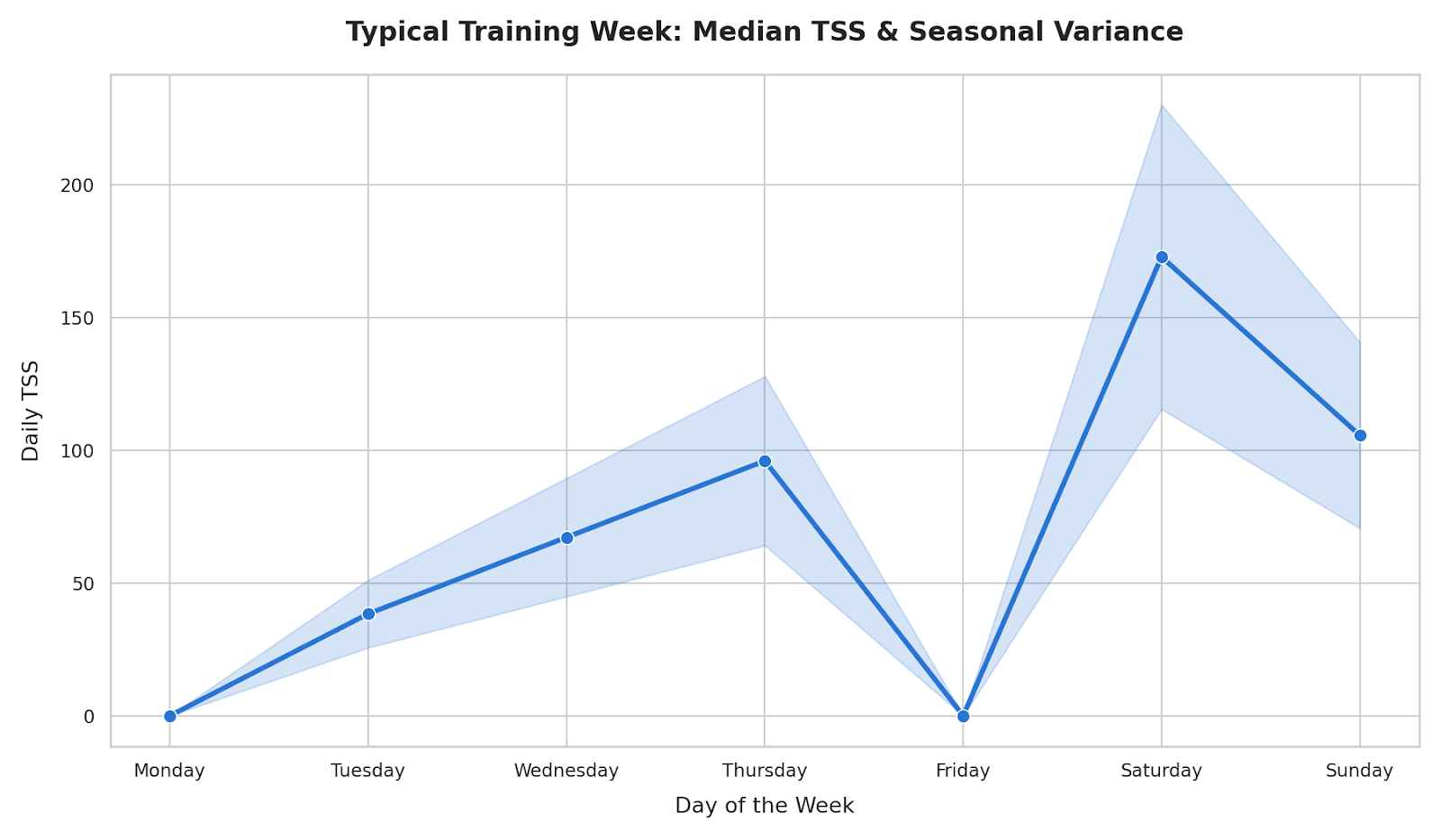
My Typical “Sprint Backlog” (derived from the 4-week Block Plan):
- Mon (0%): OFF (Office Day).
- Tue (8%): Intervals + Run (Remote Day).
- Wed (14%): Aerobic Endurance (Run).
- Thu (20%): Long Bike 2h + Strength (Remote Day).
- Fri (0%): OFF (Office Day - Battery Saving).
- Sat (36%): Long Bike / Specific work (The big load).
- Sun (22%): Long Run / Hiking (Cumulative fatigue).
2. The Sunday Ritual: Sprint Planning
This “Default Architecture” works 80% of the time. But then, life happens.
I generate my plans in 4-Week Blocks (Meso-cycles). But a block is just a theory. Every Sunday evening, I open a session with my “Coach” agent. The goal is to Commit to the upcoming week of the block, checking it against the reality of my Google Calendar.
I treat my training week exactly like a Sprint.
- The Backlog: The workouts prescribed by the Master Block Plan.
- The Constraints: My Gmail/Calendar, release deadlines, and cognitive load.
- The Definition of Done: Successfully executing the key volume (especially the Weekend Block) without generating “Technical Debt”.
The Scenario: “The Thursday Crash”
Here is a real example of a Sprint Planning prompt where the “Default Week” collided with reality.
🧑💻 Me (Sunday Prompt): “Context: Week 5 of General Prep. The Backlog (Default): - … [Standard Schedule as defined above] …
The Constraints (Reality): - Thursday (Critical): I have an all-day on-site workshop instead of my usual Remote day. I cannot do the planned ‘2h Bike + Gym’. - Friday: Remote (Exception). - Physiological State: Good, ready to push.
Task: Refactor the week. Goal: Preserve the Thursday volume (Key Session) but clear the calendar for the workshop.
3. The Refactoring Logic: “Cognitive Load Balancing”
This is where Gemini shines. It doesn’t just move blocks around; it understands the physiology of stress.
🤖 Coach Trail (Gemini - Response): “Conflict Detected on Thursday: The proposed workshop will drain your cognitive battery. Doing a 2h Bike session afterwards is suboptimal and logistically impossible.
Proposed Refactoring (Sprint Plan v1):
- Wednesday: Remain as is (Aerobic).
- Thursday (The Workshop): DOWNGRADE to Rest Day. Focus on nutrition and hydration during the workshop.
- Friday (Remote Exception): This is now your loading day. Move the 2h Bike + Gym here. Since you are remote, you can execute this high-volume block.
- Saturday/Sunday: Remain as is.
Warning: You will have a ‘Super Block’ (Fri/Sat/Sun). Ensure sleep is prioritized on Friday night.”
The AI prevents me from trying to “squeeze it in” on Thursday, which would have resulted in burnout, and creates a logical solution that utilizes the remote Friday.
Lesson Learned: AI as a Guardrail
Without the AI, I probably would have forced the run on Thursday evening: “It’s on the plan, I’m not weak, let’s do this.” Probable result: A low-quality “junk mile” session, terrible sleep, and a high risk of illness or injury 3 days later.
The AI, cold and logical, prioritized System Preservation. It applied a security patch before the bug even occurred.
4. Micro-Adjustments: The Daily Stand-up
Sometimes, even Sprint Planning isn’t enough. On Wednesday morning, I might wake up with my HRV (Heart Rate Variability) in the red.
I run a quick “Daily Stand-up” with the bot:
🧑💻 Me: “HRV dropped by 15ms. Resting Heart Rate +4bpm. I slept badly.”
🤖 Coach Trail: “Flag raised. The planned Threshold session is too taxing for today’s system status. Hotfix: Downgrade session to ‘Zone 2 Steady State’. Do not exceed 135 bpm. We will re-evaluate intensity for Saturday.”
This is Real-Time Adaptability. A static PDF plan doesn’t know you slept poorly. A human coach knows, but they aren’t awake at 6:00 AM while you’re drinking your coffee. The LLM is always there to adjust the load.
Conclusion: Consistency over Perfection
Using LLMs at this “Runtime” stage taught me one essential engineering truth: Consistency beats Intensity.
By using AI to negotiate with my professional schedule, I transformed “chaotic” weeks (where I would have normally skipped 50% of sessions) into “optimized” weeks (where I did 90% of the volume, just arranged differently).
I now have a manual workflow that works: 1. Macro: The Season Plan (Episode 2). 2. Micro: The Weekly Sprint Planning (This Episode).
However, being the “data mule” that copy-pastes metrics between Garmin, Strava, and Gemini is starting to feel tedious. I am an engineer; I hate manual repetitive tasks.
In the next episode, we are going DevOps. I will show you how I wrote Python scripts to automate this pipeline and connect the AI directly to my physiological telemetry.
To be continued…